Lithium batteries have entered people’s daily life on a large scale, but how much do you know about the technology? Where is it from? What are the steps of the lithium battery production process? This article will show you the detail about the lithium battery production process.
1. The Major Characteristics of Lithium batteries
Advantages:
Lightweight, high energy storage, high power, lower pollution, long life, small self-discharge coefficient and a wide range of temperature adaptation. It is an ideal vehicle power for electric bicycles, motorcycles, cars and large trucks.
Disadvantage:
The price is expensive and there are challenges with safety if improperly handled or housed. However, the development of existing technologies has greatly improved the safety of lithium batteries and reduced the cost.
Comparison of various types of batteries
| Lead acid | Nickel-cadmium | Nickel hydride | Lithium-ion (Traditional Liquid) | Lithium-ion (Polymer) | |
|
Lead acid |
Mass energy density, volume energy density, operating temperature range, self-discharge rate, reliability |
Mass energy density, volume energy density, self-discharge rate |
Mass energy density, volume energy density, self-discharge rate, voltage output |
Mass energy density, volume energy density, self-discharge rate, structural features |
|
|
Nickel cadmium |
Better voltage output, price |
Mass energy density, volume energy density |
Mass energy density, volume energy density, self-discharge rate, voltage output |
Mass energy density, volume energy density, self-discharge rate, structural features |
|
|
Nickel hydride |
Better capacity, voltage output, price |
Operating temperature range, better capacity, self -discharge rate, reliability |
Mass energy density, volume energy density, operating temperature range, voltage output, self-discharge rate |
Mass energy density, volume energy density, self-discharge rate, structural features |
|
|
Lithium-ion (Traditional liquid) |
Better safety, price |
Operating temperature range, better capacity, safety, price |
Price, safety, self - discharge rate, voltage output |
Mass energy density, volume energy density, structure characteristics, safety, price |
|
|
Lithium ion Polymer |
Better capacity |
Operating temperature range, better circulability, price |
volume energy density, better circulability, price |
Operating temperature range、 better circulability |
|
|
Absolute advantage |
Better capacity, price |
Operating temperature range, price |
volume energy density
|
Mass-energy density, volume energy density, self-discharge rate, structural features |
Mass energy density, volume energy density, structure characteristics, self - discharge rate, voltage output |
2. Lithium battery production process
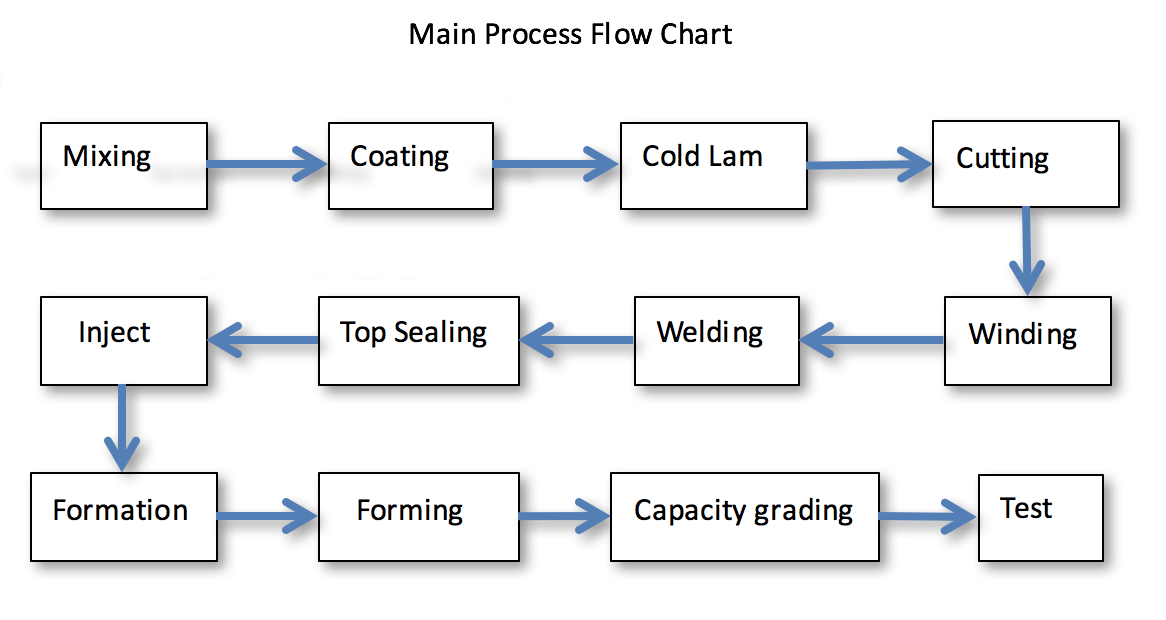
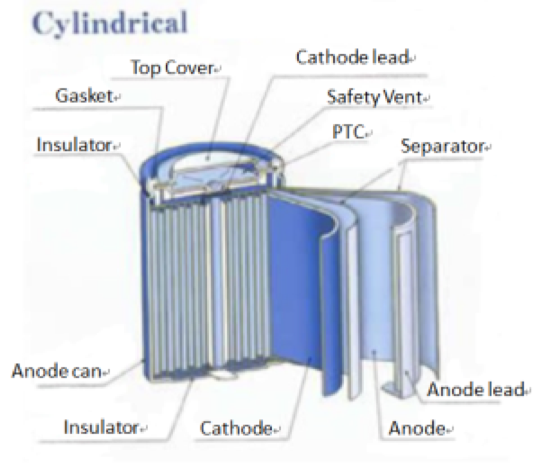
The production process of lithium batteries with different shapes is similar. The following is an example of a cylindrical lithium battery to introduce the production process.
3. Lithium battery structure
a. Positive: active material (lithium cobalt oxides), a conductive agent, solvent, adhesive, substrate;
b. Negative:active material(Graphite, MCMB,CMS), conductive agent, solvent, adhesive, substrate;
c. Separation film;
d. Electrolyte;
e. Housing:steel housing, aluminum housing, cover board, current collector, insulate plate, insulate tape.
4. The Production Process of Cylindrical Lithium Battery
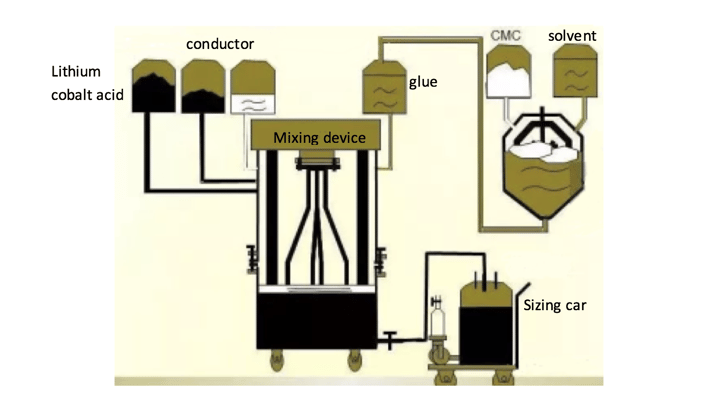
1. Negative Mixing
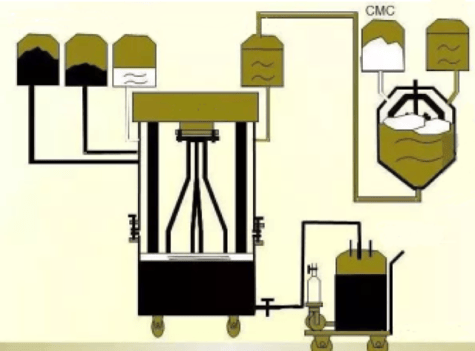
The negative electrode is composed of active material (Graphite、MCMB、CMS), a conductive agent, solvent, adhesive and substrate, and these materials are uniformly mixed by the mixing device; the detail process as follows:
2, Positive Mixing
The positive electrode is composed of active material(lithium cobalt oxides), a conductive agent, solvent, adhesive and substrate, and these materials are uniformly mixed by a mixing device; the detail process as follows:
3, Coating
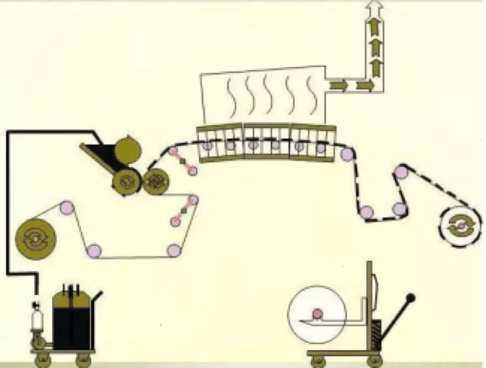
A functional description:The slurry is periodically and uniformly coated on the surface of the transfer collector fluid, drying, and positive and negative electrode rolls are made.
Theory:Coating roller rotation driven slurry, by adjusting the blade clearance to adjust the size as follows, and using a backroll or roller rotation, the slurry will be transferred to the substrate, according to the technological requirements, control the thickness of coating layer to meet the weight requirements, at the same time, by heating to remove solvent in flat out on the base material of slurry, make the solid material to good bonding with the substrate.
4. Cold lam
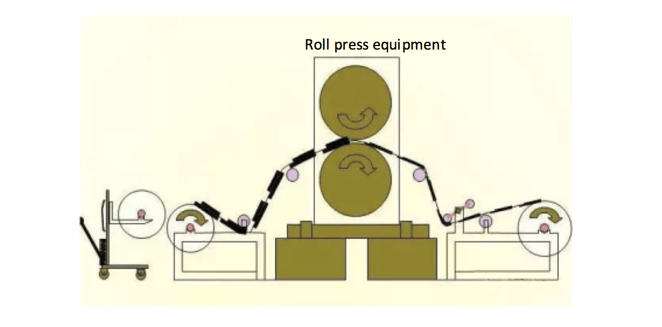
Functional description:Compaction of the poles after coating to achieve appropriate density and thickness.
Theory:The pressure is adjusted by adjusting the gap of the roller, so as to adjust the thickness and density of the electrode being compacted.
5. Cutting
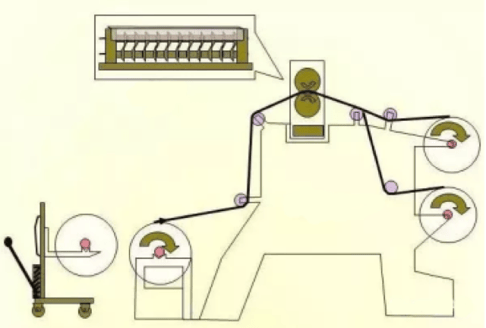
Functional description:The cold - pressed electrode is rolled up, and cut into large pieces first, and then divided into small pieces of positive and negative electrodes.
6. Baking
Functional description:The cell needs to be heated in order to seal the cell and prepare the raw cell for further processing.
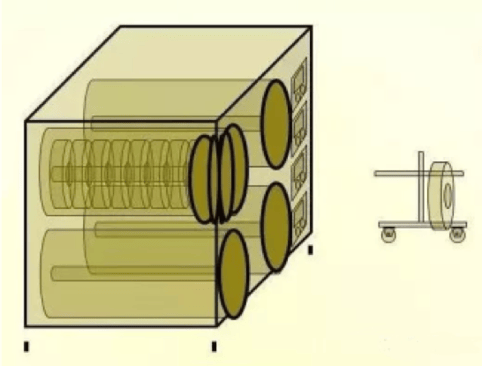
7. Winding
Functional description:Small positive and negative electrode and isolation film are wound to synthesize the bare electric cell.
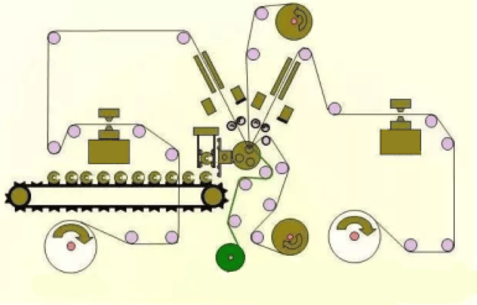
8. Put in housing
Functional description:Since Li-Ion cells are quite toxic and not safe in bare state, they must be housed in an external casing to prevent them from being exposed to the elements.
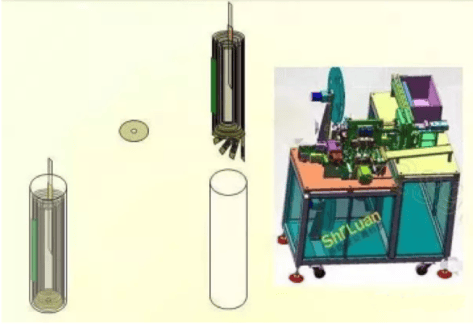
9. Spot welding
Functional description:This the seal the bottom of the casing once the cells are encased.
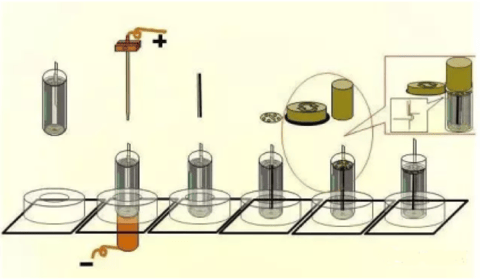
10. Baking 2
Functional description:This second heating is to complete the melding of the battery with the casing.
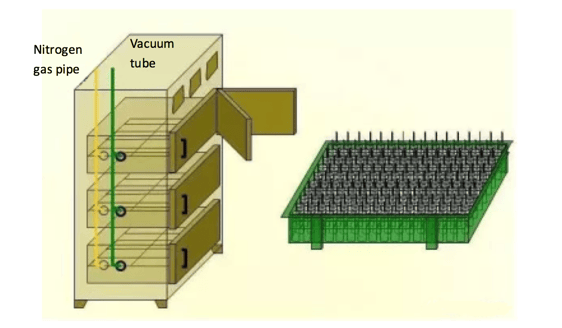
11. Inject
Functional description:This is the step where the reactive elements are added to form the final state of the cell.
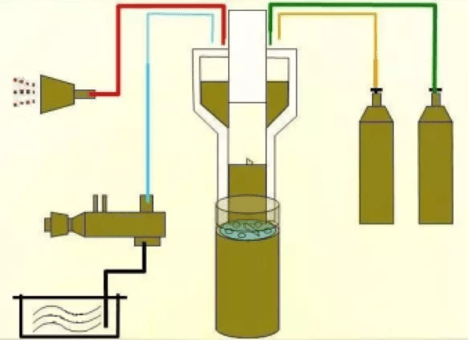
12. Cap weld
Functional description:The top cap of the cell is added at this point so as to completely encase the cell.
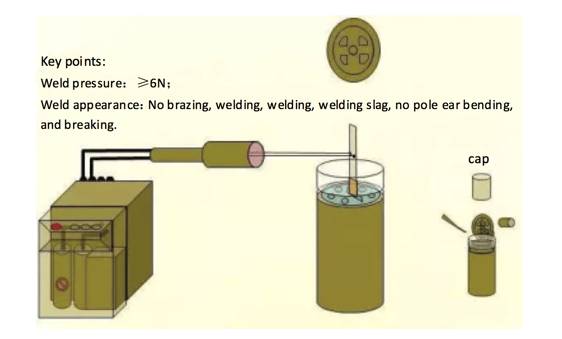
13. Washing
Functional description:This step removes any residue from previous processes so that the outside of the battery is free from any harmful compounds.
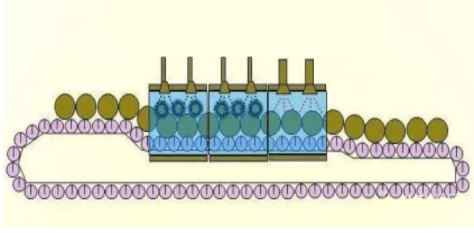
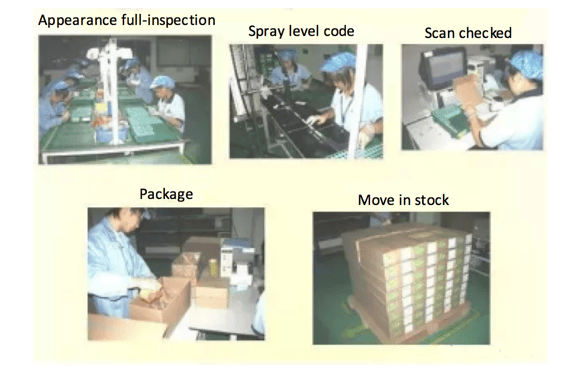
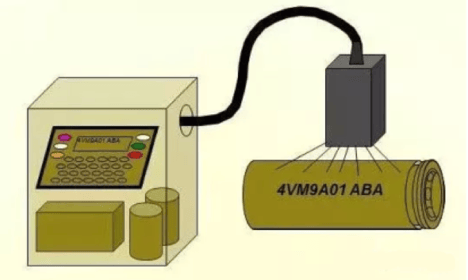
14. Spraying the code
Functional description:Batteries generally get a model number and, sometimes, a serial number. This is where that information is printed on the outside of the cell casing.
15. Formation
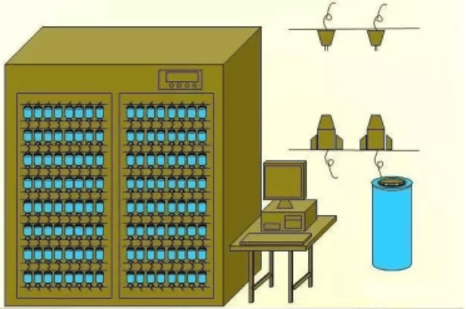
Functional description: The internal positive and negative material is activated by charging and a good SEI film is formed on the negative surface.
Formation: 0.1C CC200min to 3.95V
The assembled battery is given a certain amount of current to excite the positive and negative active substance of the battery. The electrochemical process that makes the battery capable of discharging is called formation. The battery can only be used as a power source after formation.
16. External Forming
Functional description:This is where the appearance of the cell is added finally (branding, logos, etc).
17. Capacity grading
In the manufacturing process, the actual capacity of the battery cannot be completely consistent due to technological reasons. Through certain charging and discharging detection, the process of classifying the battery according to capacity is called Capacity grading.
18. Testing & Package
Functional description:Ready to head out to power your gadgets!